The best books about Meryl Streep offer more than a list of memorable performances. They explore how she developed as an actor, how particular roles shaped her career, and why her work rewards close attention. Whether you are discovering her early films or revisiting longtime favorites, the right book can give you a fresh way to watch.
This guide introduces the main biographies and career studies, explains how they differ, and points toward related reading. It also addresses a common question: has Streep told her own story in an autobiography?
1. Understanding the Different Types of Books About Meryl Streep
Not every book about an actor is trying to do the same thing. Before choosing one, it helps to decide whether you want a life story, an introduction to the performances, or a closer look at the films themselves.
Biographies
A biography follows its subject’s life, but its scope can vary considerably. Some books concentrate on formative years; others cover a longer career more selectively. A book that ends relatively early is not necessarily incomplete—it may be designed to explain how an established public figure became that person.
With Streep, this distinction matters. Her training, early theater work, and arrival in film provide enough material for a substantial book without attempting to cover every later success.
Career studies and performance analysis
Career-focused books put the acting at the center. They may examine choices of material, recurring themes, collaborations, or the techniques that make one performance different from another.
These are useful if your main question is not “What happened next in her life?” but “What makes this performance work?”
Film-related and contextual reading
Screenplays, source novels, memoirs adapted for the screen, and books about filmmaking can also deepen your appreciation of Streep. They are not substitutes for biographies, but they reveal the material and creative environments behind particular roles.
- Choose biography for background, development, and career turning points.
- Choose performance criticism for closer attention to acting and individual films.
- Choose related reading to explore a favorite character, adaptation, or collaboration.
2. Her Again: The Essential Early-Career Starting Point
Michael Schulman’s Her Again: Becoming Meryl Streep is a strong starting place for readers interested in Streep’s beginnings. Rather than trying to summarize her entire career, it concentrates on the years in which she developed into a major actor.
That narrower focus is its defining feature. The book follows her early life, education, theatrical development, and transition into screen work, leading toward the breakthrough period associated with films such as The Deer Hunter and Kramer vs. Kramer.
What makes its approach useful?
Knowing that an actor trained extensively is one thing; understanding the stages of that development is another. Schulman gives readers a framework for seeing Streep’s early success as a process involving work, opportunity, relationships, and artistic decisions.
The theatrical background is especially valuable. Readers who know Streep primarily through cinema can better understand the importance of her college years, Yale drama training, and professional stage experience.
The book also places her early work within a personal and professional world that includes fellow actors and her relationship with John Cazale. As with any biography, it is worth distinguishing documented events from interpretations of how those events influenced the art.
Who should read it?
- New readers who want a focused narrative rather than a film-by-film reference book.
- Fans curious about Streep before she became an established screen presence.
- Readers interested in actor training, theater, and the transition to film.
The main limitation is one of scope: this is not the book to choose for extensive coverage of her later career. A closer review of Her Again can examine its storytelling and treatment of individual episodes, but the basic buying decision is straightforward: choose it when the early years are your priority.
3. Queen Meryl and the Broader Career Perspective
Erin Carlson’s Queen Meryl: The Iconic Roles, Heroic Deeds, and Legendary Life of Meryl Streep offers a different entry point. Its wider career perspective and celebratory tone make it appealing to readers who want to spend time with the familiar public figure as well as the developing artist.
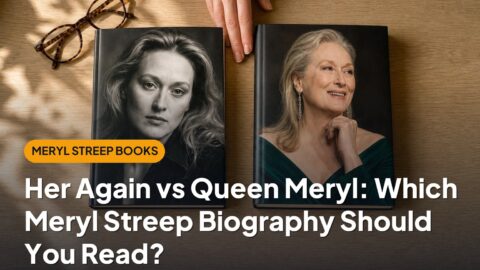
Where Her Again gains depth by concentrating on the beginning, Queen Meryl ranges more broadly across Streep’s career and public life. Its voice is lively and openly admiring, so your enjoyment may depend partly on whether that style matches your reading preferences.
Her Again vs. Queen Meryl: the quick distinction
| Book | Main emphasis | Best suited to |
|---|---|---|
| Her Again by Michael Schulman | Streep’s formation and early professional breakthrough | Readers seeking a concentrated account of how her career began |
| Queen Meryl by Erin Carlson | A broader, celebratory look at her roles, career, and public presence | Readers wanting a lively overview that extends beyond the early years |
Neither approach automatically makes one book better. If you usually enjoy biographies organized around personal and artistic development, start with Schulman. If you are drawn to a wider range of recognizable roles and an enthusiastic account of Streep’s cultural stature, Carlson may be the more natural choice.
The books can also complement each other. Reading Her Again first establishes the early-career foundation; following it with Queen Meryl broadens the view. A detailed comparison is useful for readers choosing just one, but beginners do not need both to get started.
4. Looking Closely at the Acting: Career and Visual Studies
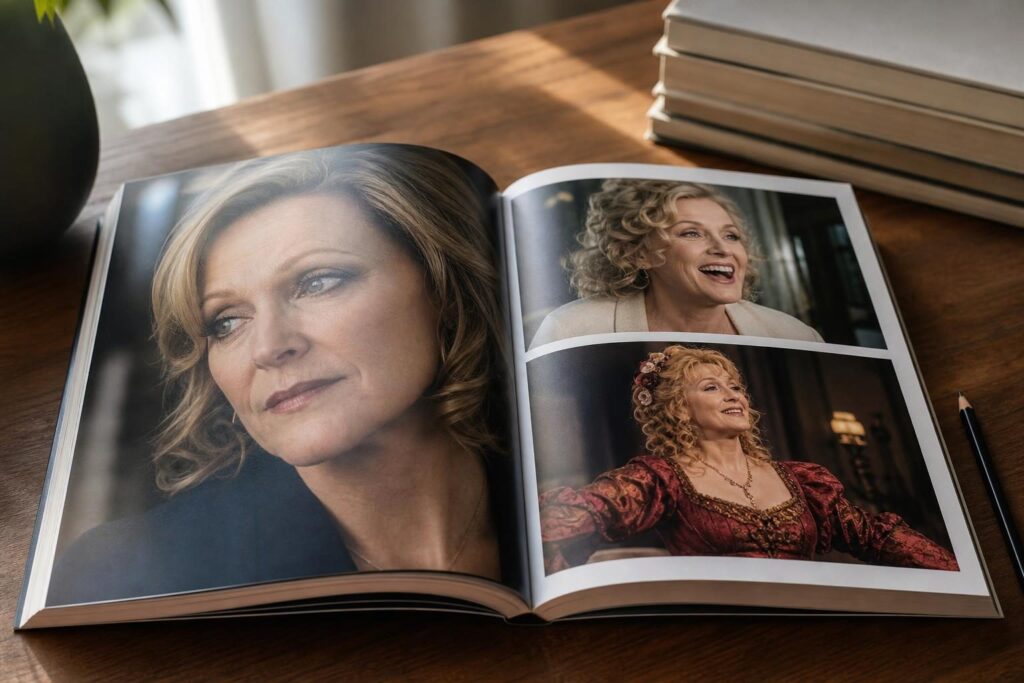
Biography explains circumstances. Performance criticism asks what happens on screen. For an actor whose work spans drama, comedy, musicals, and character-driven ensemble films, that second approach is particularly rewarding.
Karina Longworth’s Meryl Streep: Anatomy of an Actor is a useful title to consider here. It approaches Streep through selected performances, combining discussion of her work with a strongly visual presentation.
What can performance analysis reveal?
Good criticism directs attention toward choices that viewers may register without consciously examining. These can include posture, rhythm, vocal delivery, stillness, or the relationship between an actor’s performance and the camera.
With Streep, discussion often begins with accents and physical transformation. Those are important, but they are only part of the picture. A career study can encourage you to notice emotional restraint, comic timing, shifts in authority, and the way a character behaves differently with different people.
- Voice: Listen for pace, emphasis, hesitation, and changes in register—not just accent.
- Movement: Notice how posture and gesture establish age, confidence, or social position.
- Interaction: Watch what changes when another character enters the scene.
- Film style: Consider how editing, framing, costume, and sound contribute to the performance.
A visually oriented book is also worth examining in print before buying, if possible. Page size, image reproduction, and layout can contribute meaningfully to the reading experience.
5. Has Meryl Streep Written an Autobiography?
Meryl Streep has not published a full-length autobiography. The principal life-and-career books discussed here are written by other authors, not by Streep herself.
This distinction is easy to overlook when a cover prominently displays a famous name. A biography is someone else’s account of a life. An autobiography is the subject’s own sustained account, while a memoir may concentrate on a particular period or theme.
Where can you find her own perspective?
Interviews, recorded conversations, speeches, and discussions of individual films provide opportunities to hear Streep describe her work. These sources can complement a biography, especially when you want to compare an author’s interpretation with her own comments.
They do not, however, form a single continuous life narrative. An interview promoting a film has a different purpose from a retrospective conversation, and a speech may be crafted for a particular occasion.
When assessing a book, check the title page, author credit, and description. Do not assume that a publication is authorized, written with Streep’s participation, or based on new interviews with her unless that involvement is clearly stated.
6. Books Behind the Films: Novels, Memoirs, and Adaptations
Some of the most rewarding companion reads are not books about Meryl Streep at all. They are the works that supplied characters and stories she later interpreted on screen.
Reading a source book alongside its adaptation reveals what a performance contributes beyond the written description. It also helps separate the actor’s decisions from changes made during adaptation.
Useful places to begin
- Kramer vs. Kramer by Avery Corman: A way to explore the family conflict behind the film and compare how the story presents its parents.
- Sophie’s Choice by William Styron: A substantial literary companion to one of Streep’s best-known dramatic performances. Both the novel and film contain deeply distressing material involving the Holocaust and sexual violence.
- The Devil Wears Prada by Lauren Weisberger: An accessible opportunity to compare a novel’s characterization with the screen version of Miranda Priestly.
- Julie & Julia by Julie Powell: One of the source books for the film, useful for understanding its contemporary narrative strand.
- My Life in France by Julia Child with Alex Prud’homme: Another key source for Julie & Julia, offering context for the Julia Child story portrayed in the film.
These works should not be treated as factual guides to Streep’s life or acting process. Their value lies in comparison: what was retained, what changed, and how a character became a screen presence.
If you add a screenplay to your reading, check which version it is. A published shooting script, an earlier draft, and a transcript of the finished film can differ substantially.
7. Choosing, Finding, and Reading Your First Book
You do not need a complete shelf to begin. One well-chosen book and a few carefully selected films can provide a satisfying introduction.
Match the book to your main interest
- For her beginnings: Start with Her Again.
- For a broader, enthusiastic career portrait: Consider Queen Meryl.
- For close attention to selected performances: Look at Meryl Streep: Anatomy of an Actor.
- For a favorite film: Try its source novel, memoir, or an appropriate screenplay edition.
Check the practical details
Library catalogs are useful for confirming the author, full title, publication details, and available formats. When buying a used copy, check its condition and whether the listing matches the edition you want.
For any career book, note when it was published. A book cannot cover performances or developments that came afterward. That does not make it less valuable, but it does define its reach.
Preview the notes and bibliography where available. Clear sourcing helps you understand where anecdotes originate and gives you a route into further reading. A confident narrative voice is not, by itself, evidence of privileged access.
Pair reading with viewing
A simple reading-and-watching routine can make the material more memorable:
- Watch a film before reading its detailed analysis if you want to avoid spoilers.
- Note one or two claims the author makes about the performance.
- Revisit a scene with those observations in mind.
- Allow yourself to disagree with the interpretation.
The aim is not to find one definitive explanation of Streep’s work. It is to build a richer understanding while keeping your own response to the performances.
8. Conclusion: Start With the Perspective That Interests You
The strongest books about Meryl Streep serve different purposes. Her Again illuminates her formation, Queen Meryl offers a wider celebratory portrait, and Meryl Streep: Anatomy of an Actor turns attention toward the performances themselves.
Choose the perspective that matches your curiosity, then branch into interviews, source books, and film-specific reading. Together, these approaches offer a fuller picture than any single volume can provide.

1 Comment